In the rapidly developing DeFi world, even the smallest thing can impact the total outcome. There is a detail that is often ignored by beginners but which is nonetheless critically important for any serious trader – slippage. For anyone engaged in trading slippage is something that you must understand. Whether you’re trading tokens on Uniswap, yield farming, or executing larger trades, slippage can eat into your profits, or on the contrary, generate unexpected losses.
So, in this article, we’ll discuss what is slippage in crypto, what is slippage tolerance, why it occurs in DeFi, how it affects your trades and what strategies are useful to protect yourself.
The price slippage meaning is as follows: it is a discrepancy between the expected price of a trade, and the price at which it is actually executed. This usually occurs in volatile or illiquid markets when prices can move quickly before your transaction is confirmed.
Traders often complain that they’ve been “slipped” when a trade is executed at a worse price, either because buyers pay more than expected or sellers receive less. Though slippage is often considered a bad phenomenon, it isn’t always the case; in rare instances, slippage in crypto can actually work in your favor if the market moves in a direction that’s favorable to your order.
Example:
You attempt to purchase 1 ETH at $2,000, but because the market moves fast your actual buying cost ends up being $2,020, which gives you a 1% slippage.
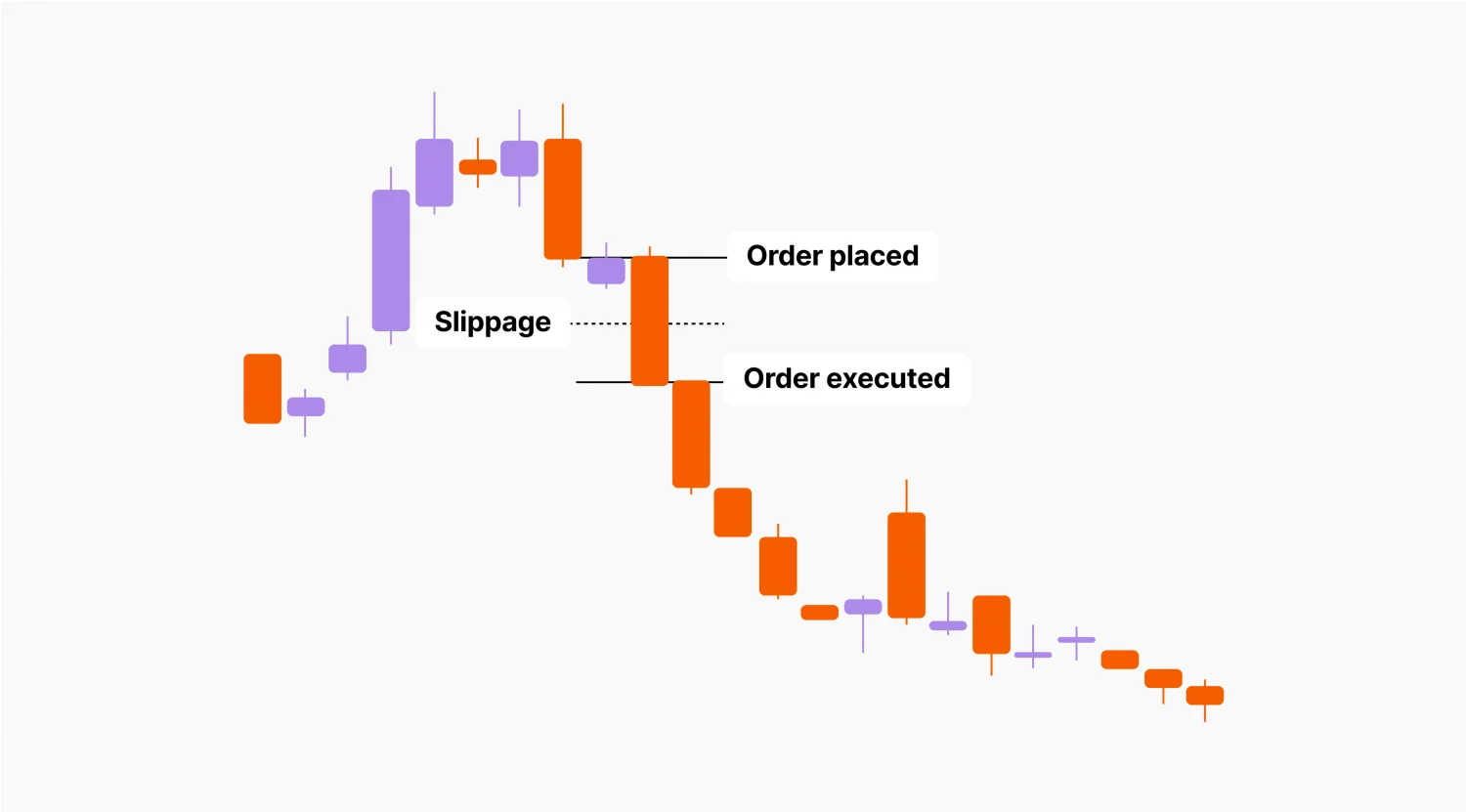
Crypto slippage is a risk primarily concerned with market orders, which fill at the best available cost regardless of the direction of the spread. However, with rapid price swings the last fill price can be different than what it previously displayed.
To understand why slippage occurs in DeFi, it is required to understand how Automated Market Makers (AMMs) operate.
AMMs enable trading without the need for a conventional order book or counterparty. Instead, the prices are calculated by algorithm via the proportion of assets in the liquidity pool. The most common model is that of the Constant Product Market Maker, defined as:
x * y = k
In this formula, x and y are the amounts of two assets in the pool and k is a constant.
When you trade on an AMM, your trade alters the balance of the pool, and that is how price is formed. The greater the trade size in relation to the size of the pool, the greater the price movement – slippage.
Slippage in crypto can also happen as a result of differences in prices from when you send a transaction to when it settles on the blockchain. The market price might move during congestion and confirmation times may slightly delay.
DeFi slippage is quantitatively determined by two factors which are interlinked: the size of the liquidity pool and the volatility of the market. These factors mainly contribute to a traded price’s proximity to the expected price.
Liquidity Pool Size. In decentralized protocols (DEXs), like Uniswap, SushiSwap, or PancakeSwap, trades are mediated through automated market makers (AMMs) with the help of liquidity pools. The size of these pools, or the value in tokens being locked in them, has a direct relationship with price stability.
Larger pools can absorb larger trades without overly impacting the token price, so the slippage will be lower. The same cannot be said about small pools, which are more influenced by trade size. Even small trades can move the price, leading to increased slippage.
For instance, exchanging $10,000 value of ETH in a liquidity pool with $100 million liquidity could incur minimal slippage. But the identical trade in a pool of just $100,000 in total value could dramatically shift the token ratio and price.
Volatility. Cryptomarkets are well-known for being volatile and such price unpredictability means there is a higher risk of slippage. In fast-moving markets, the value of a token can fluctuate between the time a transaction is requested and the time it is confirmed on-chain — occasionally in mere seconds.
For example, if the price is volatile, it may surge or plummet and become more likely that your trade will be filled with a worse rate. It’s particularly problematic in DeFi as gas fees and block confirmation delays can exacerbate the execution gap. And when low liquidity is combined with high volatility, slippage can get quite bad with large disparities in quoted and executed prices.
The depth of the liquidity pool and the volatility work together at the heart of slippage mechanics in DeFi. Traders ideally will have knowledge of these factors and can plan accordingly, tweaking aspects like slippage tolerance settings or utilizing limit orders to help alleviate risk.
The most intuitive cause of slippage in DeFi is the size of trade as compared to the liquidity available in the pool. The bigger the trade, the more it can move the price in the automated market maker (AMM) model — at least in pools that have relatively low liquidity.
How Trade Size Affects Slippage
In DeFi, the majority of decentralized exchanges use the AMM such as the Constant Product Formula (see the section above). In this paradigm buying a lot of a token always means you need to take strictly worse prices as you “move along the curve“, you move the price up (or down as well) as you fill rests of available liquidity.
Small trades reflecting a minor portion of the pool size yield very low price impact and are generally traded near the quoted price range. This is because large trades relative to the size of a pool lead to more price slippage as they distort the ratio of the token in the pool.
__________________________________________________________________
Example: Let’s take an example: we have a liquidity pool of 100 ETH and 100,000 USDC. If you’re trying to buy 1 ETH with USDC, the price impact is very small. But if you attempt to buy 10 or 20 ETH at once, you suck a bunch of the ETH out of the pool, drastically raising its price relative to USDC, and thus you face slippage.
__________________________________________________________________
Slippage and DeFi Tools
To help you control this effect, most DEX interfaces let users set a slippage tolerance – the maximum permissible price deviation they are willing to tolerate before a trade is canceled. But setting it too high might result in overpaying, and setting it too low may result in failed transactions in changing markets.
In DeFi trading, price impact is closely related to price slippage. It’s important for traders to be aware of the difference, especially when they’re using DEXs or interacting with liquidity pools.
We have already figured out what price slippage is and now let’s see what the price impact is. The price impact in crypto is the change in price one would expect from the trade itself, depending on how large the trade is in relation to the liquidity available in the pool. That happens automatically when a trade occurs, and it is what AMMs are intended to do. More generally, trades that are big relative to the size of the pool will "move the curve" more, and so will have a higher price impact.
Below is the summary table with the comparison on slippage vs price impact:
| Feature | Price Impact | Header 3 |
|---|---|---|
| Definition | The impact of your trade on price | Spread between the price at which an order is quoted or advertised and the price at which that order is executed |
| Cause | Trade size vs. liquidity | Market volatility, delays, price impact |
|
When it happens |
Immediately upon executing trade | Between placing the order and the transaction confirmation |
| Can be predicted? | Yes, it is often shown before trade | No, it is different every time you look, due to real-time market movements |
| Controlled by? | Trade size and pool liquidity | Network conditions, other traders’ actions |
Slippage may shave into your profits or trigger mayhem during volatile markets. Thankfully, there are some smart techniques and settings you can apply to minimize slippage risk when trading crypto in DEXs.
Slippage tolerance is a core setting in DEXs that allows you to specify how much price movement you are willing to tolerate from the order being placed to the order being executed. Otherwise, at a bad price the trade will be rejected instead of being executed. Slippage tolerance manipulation is an easy and powerful method for controlling risk when the market is volatile or when trading in pools with little liquidity.
When trading with large amounts of tokens, this can cause high price slippage and unfavorable execution prices. One method to reduce this problem is to break up large orders into smaller ones.

The more transactions, the higher the overall gas costs. Weigh savings of decreased slip against added costs. Set Slippage Tolerance on each leg according to market conditions. There are of course, volatile times where prices fluctuate even on small trades, don't engage.
Breaking up big orders is one of the most effective slippage-avoidance tactics in DeFi. Whether you do this by yourself or use aggregators to automate the process, splitting large trades helps you to protect your capital, particularly when trading in low-liquidity conditions.
It can be helpful to conceptualize slippage when you’re trying to understand it, but seeing it in action makes things much clearer. Here are some examples of how slippage can impact your decentralized finance (DeFi) trades.
Example 1 : Stable coin swap with low slippage.
You want to convert 1,000 USDC to USDT on a DEX that is highly liquid and non-volatile. The price you expect to swap is 1 USDC = 1 USDT. In fact, the price filled has been 0.9998 USDT, the slippage is 0.02%, and as a result you get 999.80 USDT instead of 1.000.
Example 2: Big Trade Flushed in a Small Liquidity Pool
You have 10 ETH and you want to trade it for a new altcoin (ALT) in a network with $100,000 liquidity. The price (quoted) is 1 ETH = 1,000 ALT, and the price realized after slippage is 1 ETH = 920 ALT, therefore the slippage is 8%. So, you get 9,200 ALT instead of 10,000 ALT.
Slippage can be caused by a number of factors, but with appropriate risk controls, like slippage tolerance, aggregators and order splitting, you can avoid slippage cost mistakes in DeFi.
In decentralized finance (DeFi), slippage and MEV (Maximal Extractable Value) are serious problems that can cause trading to be incredibly inefficient and costly in certain scenarios. Though they are distinct, they tend to coincide, especially when the trades are high value or high volatility.
How does slippage and MEV collide? Slippage is what creates the opportunity, and MEV bots are exploiting it. For example:
This is significant, because slippage + MEV = worse execution and loss of capital. The slippage tolerance is too low during volatile periods leading to failed trades and wasting your gas fees. MEV is about scanning for preferential windowlects that regular users cannot see with bots by leveraging blockchain transparency and time-lag.
Slippage is a silent portfolio assassin in DeFi, as some traders face exposure to slippage while trading heavy-swinging volatile tokens, against low liquidity pools, or under heavy network traffic. Fortunately there are effective ways and several practices to protect your assets from over slippage and MEV risks.
Here are some slippage protection tools:
Slippage in DeFi is an essential element of trading, but it can be overlooked. Whether you’re exchanging tokens, providing liquidity, or yield farming, slippage can affect your return, and often in a considerable amount way. Knowing how slippage operates, why it happens, and how to prevent it can empower you to better safeguard your funds and make more strategic trades.
But with the right tactics and knowledge, you can stay ahead of the curve, and prevent slippage from cutting into your gains.