What is a blockchain oracle, what are their types and features, and why do decentralized networks need them? Here you will find the answers to these and other questions.
Whether you’re fresh to blockchain or an experienced WEB3 user, wrapping your head around blockchain oracles is a must. These are the tools that act as the bridge between the blockchain networks and the real world, and allow dApps based on smart-contracts to make decisions on the real world event data. Without oracles, smart-contracts can operate only with on-chain data, hampering the potential that their utility and applicability could provide.
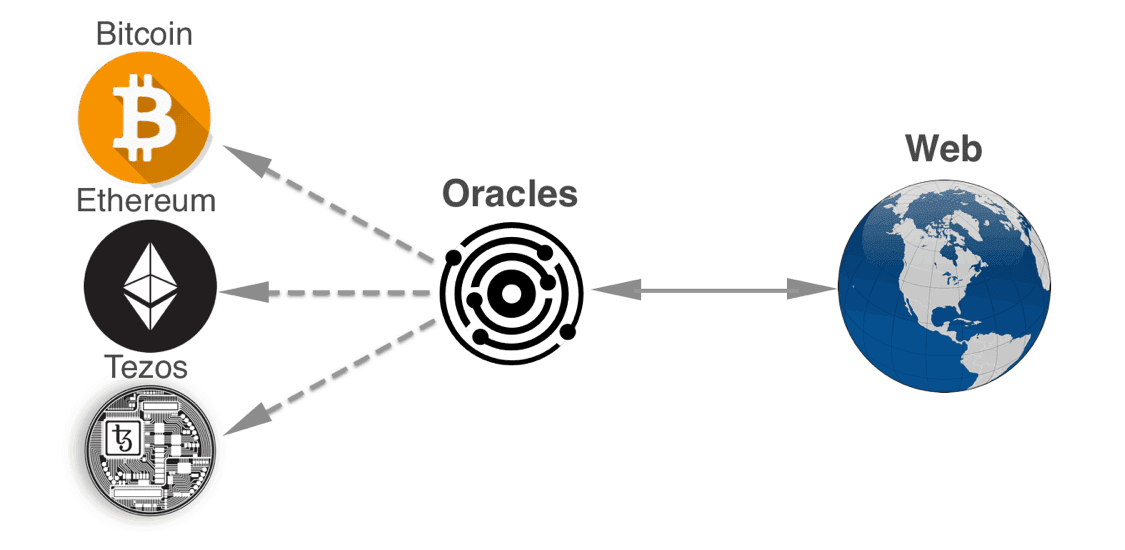
Price feeds, weather data, APIs and even IoT inputs, there’s a whole world of smart-contract power unlocked by oracles. In this article, we’re going to take a look at what an oracle is in crypto, their types, and the way they work. Besides, we consider some of the biggest use cases and areas where they are effective, and highlight some of the likely risks.
Blockchains are by design walled gardens that cannot reach external data provided outside of their network — an obstacle referred to as the “oracle problem”. There are no Bitcoin oracles since this network does not support smart-contracts, but it is certainly good for decentralized applications (dApps) running on Proof-of-Stake (PoS) blockchains (i.e. most other networks). To operate properly, these dApps depend on off-chain, real-time data, and oracles provide it.
A blockchain oracle helps solve the problem by providing trusted data bridges. They allow blockchains to be able to fetch and verify external inputs, thereby enabling a variety of use cases: from decentralized finance (DeFi) and insurance to NFTs and prediction markets.
There are many types of oracles serving various roles. They can be classified by several factors, including data source, level of decentralization, and governance. Here we consider the classification by data flow direction.
Pull-based oracles are by far the most prevalent at present. They import off-chain and export on-chain the data necessary for smart-contracts. This approach has benefits such as cost effectiveness; and decreased latency and improved freshness of data for low-latency applications.
The push-based oracles work in the reverse direction. Rather than query for data, they enable smart-contracts to provide commands to off-chain systems. This could mean instigating bank payments, commanding data storage providers, or actuating IOT devices, such as unlocking a car door once an on-chain rental payment has been received, for example.
Crosschain oracles enable cross-border communication between two or more blockchains. They can read and write data between chains, which also allows for transferring assets and cross-chain operations such as, for example, running a contract on one blockchain and using the data from another or bridging tokens for use outside of their home network.
These oracles enable additional compute functionality by securely doing off-chain computation in the VRF oracles. They are particularly useful when you can’t execute on-chain, due to tech limitations, costs, or legal issues. The examples include Chainlink Automation for event-driven smart-contract execution, zero-knowledge proofs for privacy, and verifiable randomness functions used to generate fair and impossible-to-manipulate random results.
So, what is a blockchain oracle and why do these networks need it? Blockchains aren't able to access the outside world by default, therefore they work in a closed environment and are completely self-contained. Oracles fill in this gap by supplying smart-contracts with real world data from the outside world and delivering it securely. Critically, oracles are not sources of data, instead they serve as trusted intermediaries between off-chain data and the blockchain.
Crypto oracles work in both directions: they allow off-chain data to be brought onto the blockchain, as well as transmitting blockchain data off-chain, for example into traditional banking applications. That connectivity will open up all manner of enterprise applications. For instance, businesses can use blockchain for supply chain tracking or financial instruments such as bonds that rely on third-party interest rates — all without having to overhaul their existing infrastructure.
A lifeline for many industries, a blockchain oracle is fundamental to the working of smart-contracts in several industries. By joining blockchains with external data sources, they enable new use cases for decentralized finance (DeFi), insurance, supply chains, gaming, and more.
Price oracles are among the most popular in DeFi, feeding real-time price data for dozens of cryptocurrencies and other financial instruments.
Price feeds are leveraged to estimate the amount of loans supported by collateral, liquidating when ratios drop below a certain number. Besides, oracles are important for collateral monitoring in DeFi borrowing/lending platforms. They get details on the collateral value for the platform to: calculate the loan-to-value (LTV) ratio, find out if a loan is undercollateralized and liquidate, and keep an eye on the state of the collateralization ratio and avoid liquidation.
Hybrid smart contracts bring together on-chain code and off-chain data through the use of oracles. That integration makes it possible for smart contracts to manage more complex real-world situations – insurance payments based on weather data, for example, or automated supply chain actions. Oracles are the glue that supports these contracts being able to supersede the capabilities of their underlying blockchain, and support more sophisticated dApps.
Oracles are vital to dynamic NFTs and blockchain games. In the dynamic NFTs, oracles provide real-world data, e.g., the weather, the scores of a sports game or market prices, in order to change metadata and, thus, the NFT itself over time. In the gaming world, oracles allow events and statistics to change based on real-world occurrences, resulting in more interactive and realistic gaming experiences. What oracles do, essentially, is allow these digital assets and experiences to mirror what is happening in the real world.
The "oracle problem" is still relevant because it is challenging to input deterministic smart contracts using unpredictable data outside the system. Since blockchains are meant to be trustless and immutable, bringing external data into a blockchain through an oracle is dangerous: the oracle, if corrupted or untrustworthy, threatens the smart contract relying on it.
Smart contracts are walled gardens and they need honest external input in order to work in the real world. This external data is provided by oracles, and with them comes a point of potential failure. The smart contract could take away data or transmit it incorrectly if the data source or transmission is defective.
The centralized oracles that have a single owner are the biggest vulnerability. If that self refers to a cash-holding oracles, or any oracles for that matter, and the oracles are hacked, malfunctioning or malicious, it can spit out false data which can be detrimental to all smart contracts that are dependent on the information. This is against the fundamental concepts of blockchain being decentralized and trustless.
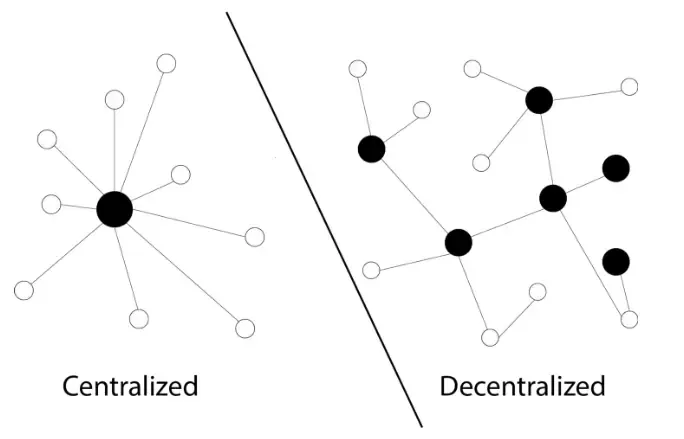
To resolve such issues, Decentralized Oracle Networks (DONs) divide data-providing into duties of multiple independents. This makes it more secure and reliable but also brings some new challenges – coordination over multiple nodes, enforcing data consistency and accuracy. Although challenging, DONs are a potential answer to the oracle problem for trying to preserve the integrity of the blockchain and facilitating real-world use.
While interoperability solutions and decentralized oracles undoubtedly both help to enhance the utility of blockchain networks, they address very different problems. Here’s a look at what they are and what their distinctions are.
We have already considered what blockchain oracles are, so now let’s take a look at interoperability solutions. These solutions allow blockchains to interoperate (Ethereum – Polkadot, Solana – Cosmos). They aim to establish an interconnected system of assets, messages, or smart contract calls that can flow freely between chains.
The examples of these solutions are: Polkadot (with parachains and XCMP), Cosmos (through IBC – Inter-Blockchain Communication), LayerZero, Wormhole, Axelar, and Multichain.
Here are the key differences between interoperability solutions and oracles:
| Feature | Blockchain Oracles | Interoperability Solutions |
|---|---|---|
| Purpose | Bring off-chain (real-world) data on-chain | Enable cross-chain communication and asset exchanges on different chains |
| Data Source | External (e.g. APIs, IoT, web feeds) | Other blockchains |
|
Use Cases |
Price feeds, event determination, insurance triggers | Cross-chain exchange, dApps on multiple chains, bridging assets |
| Trust Model | Relies on oracle network decentralisation and reputation to enforce good behaviour | Is dependent on protocol agreement and relayer security |
| Examples | Chainlink, Band, API3 | Cosmos IBC, Polkadot, Wormhole, LayerZero |
Interoperability solutions and decentralized oracles are synergistic. For instance, a DeFi app on Avalanche could leverage Chainlink oracles to obtain pricing data and LayerZero to bridge liquidity from Ethereum. A prediction market may use an oracle for information about events and a bridge protocol to payout in tokens of different chains.
Although the two mechanisms (e.g., interoperability protocols and oracles in crypto) increase the power of smart contracts, they work in different layers: oracles bridge off-chain worlds to a blockchain while interoperability links multiple blockchains. Combined, they contribute to more powerful, integrated, and helpful dApps.
Below is an overview of several most successful cases in this field. Each of these projects and networks plays a fundamental part in enabling smart contracts to securely and reliably interact with external data:

These oracle networks in crypto power a growing number of smart contract applications and by using them, you can securely connect to real-world data in a decentralized way, a crucial component for the success of DeFi, Web3, insurance, gaming, and so much more.
So, here we have considered what is an oracle in blockchain. These are an essential tool for interfacing between decentralized networks and the as-is world. Blockchains have been designed to be isolated by nature, for security and immutability, so until now they’ve not been able to interact in the realm of external data, from financial market prices and weather, to sports scores and IOT sensor inputs. This connectivity is how smart contracts realize their full potential to have real-time reaction to actual events as they happen.
As the blockchain space matures, oracles will become increasingly vital not only in DeFi, but in all aspects of the insurance, supply chain, gaming and other industries. This power, however, comes from another side of the coin: how to secure and make this infrastructure reliable is still a big issue not only for developers but also for its users.
In other words, blockchain oracles are the access point by which blockchains start to connect beyond static code to the real world and become dynamic, data-driven applications. For anyone constructing or interacting with smart contract ecosystems, knowing how they do so — and how to assess their risks and strengths — is indispensable.